





























 Back
Back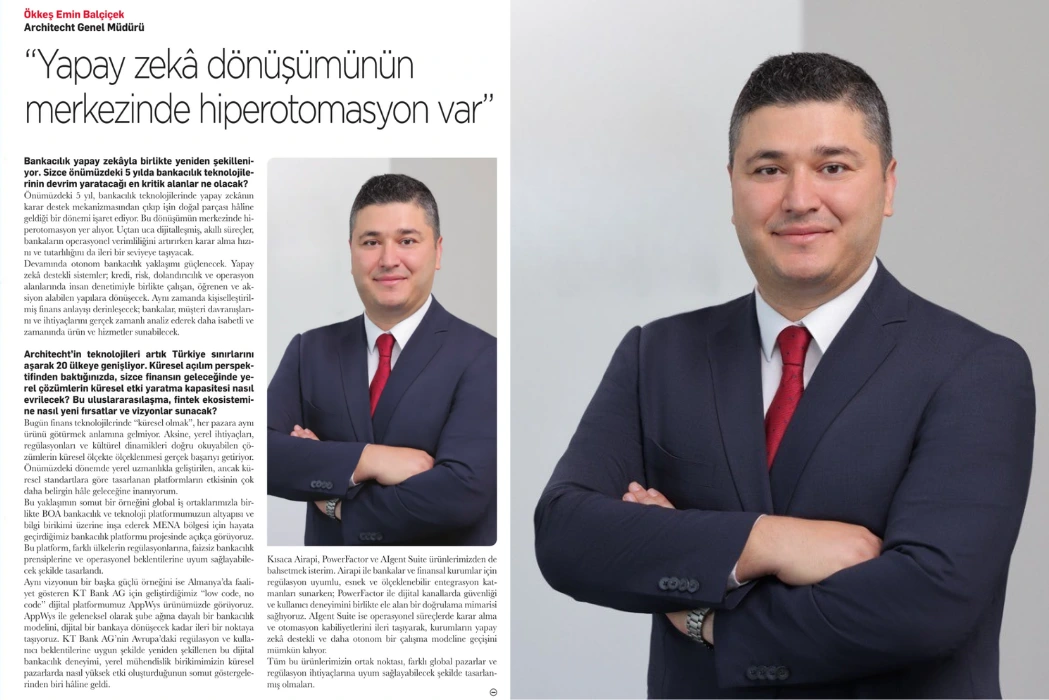
PSM Magazine – February Issue
Banking is being reshaped with artificial intelligence. In your opinion, which areas of banking technologies will create the most critical breakthroughs in the next five years?
The next five years will mark a period in which artificial intelligence in banking technologies moves beyond being merely a decision-support mechanism and becomes a natural part of operations. At the center of this transformation lies hyperautomation. End-to-end digitalized, intelligent processes will increase banks’ operational efficiency while significantly improving the speed and consistency of decision-making.
Following this, the autonomous banking approach will become stronger. AI-powered systems will evolve into structures that work alongside human oversight—learning, making decisions, and taking action in areas such as credit, risk, fraud, and operations.
At the same time, the concept of personalized finance will deepen. Banks will be able to analyze customer behaviors and needs in real time, enabling them to offer more accurate and timely products and services.
As Architecht, we position AI-powered banking capabilities as a complementary competence across all our products and platforms, and we continue to invest in this field through product, technology, and engineering initiatives. Our goal is to help banks preserve their existing strengths while making them more scalable, more agile, and capable of responding faster to changing customer expectations.
Architecht’s technologies are now expanding beyond Türkiye into 20 countries. From a global expansion perspective, how do you see the capacity of local solutions to create global impact evolving in the future of finance? How will this internationalization bring new opportunities and visions to the fintech ecosystem?
Today, being “global” in financial technologies no longer means delivering the same product to every market. On the contrary, true success comes from solutions that can accurately interpret local needs, regulations, and cultural dynamics, while scaling globally. In the coming years, I believe platforms developed with local expertise but designed according to global standards will have an increasingly visible impact.
We clearly observe a concrete example of this approach in the banking platform project developed for the MENA region, which we built together with our global partners on the technological foundation and expertise of our BOA Banking and Technology Platform. This platform was designed to comply with the regulations of different countries, the principles of participation banking, and varying operational expectations. In this project, the contributions of Architecht engineers—particularly in platform architecture, integration capabilities, and scalability—played a decisive role in its success.
Another strong example of this vision can be seen in our low-code, no-code digital platform AppWys, which we developed for KT Bank AG in Germany. With AppWys, we are transforming a traditionally branch-based banking model into a highly advanced digital banking experience. This digital transformation, reshaped according to the regulatory and user expectations in Europe, has become one of the most tangible indicators of how local engineering expertise can create strong impact in global markets.
I would also like to briefly mention our Airapi, PowerFactor, and AIgent Suite products.
With Airapi, we provide regulation-compliant, flexible, and scalable integration layers for banks and financial institutions.
With PowerFactor, we offer an authentication architecture that addresses both security and user experience across digital channels.
Meanwhile, AIgent Suite advances decision-making and automation capabilities in operational processes, enabling organizations to transition toward AI-powered and more autonomous operating models.
What these products share in common is that they are designed to adapt to the needs of different global markets and regulatory environments.
These efforts demonstrate an important insight: solutions built on the right technological foundation can address not only the needs of a single country, but also those of an entire region—or even a global ecosystem. Software developed with flexible architectures and capabilities can evolve without being rewritten, even as regulations change. This provides financial institutions with faster scalability, lower total cost of ownership, and the ability to deliver products to market more quickly.
From a broader perspective, this wave of internationalization creates two key opportunities for the fintech ecosystem.
The first is the expansion of financial inclusion. Digital, accessible, and needs-based products can be developed for customer segments in different geographies that have previously been underserved.
The second is the cross-border flow of knowledge and engineering capabilities. As expertise gained in local markets is transferred to global projects, both product quality improves and new standards begin to emerge across the industry.
Ultimately, creating global impact with local solutions will no longer be an exception in the future of finance—it will become the new norm. At the center of this transformation will be organizations that take a long-term perspective on technology, view regulations not as constraints but as design inputs, and position engineering as a strategic value.
At Architecht, we are focused on building the financial infrastructures of tomorrow with precisely this vision.