




























 Back
Back
The RACI Approach and Stakeholder Management: Reconsidering Role Allocation and Communication Dynamics in Project Processes
In today’s project management practices, the multi-stakeholder and dynamic nature of projects requires approaches that go beyond technical planning and emphasize human-centered and communication-focused perspectives. This study examines the RACI approach as a responsibility assignment tool and analyzes its interaction with stakeholder management. The primary aim of the study is to assess the impact of clearly defined roles on project performance. The study is based on a literature review and conceptual analysis.
1. Introduction
The widespread adoption of project-based working models has necessitated collaboration among individuals from diverse areas of expertise toward common goals. While this enhances organizational complexity, it also highlights the critical need for clearly defined tasks and responsibilities. Role ambiguity often leads to communication breakdowns and process inefficiencies.
In this context, the RACI approach—one of the tools used in project management—systematically defines who is responsible for carrying out tasks and clarifies how stakeholders are involved in the process. This study examines the relationship between the RACI approach and stakeholder management.
2. Theoretical Background
Stakeholder management is a process that involves identifying all actors affected by a project and planning the relationships to be established with them. The literature emphasizes that stakeholders are not only those affected by project outcomes, but also actors who directly shape project processes (Freeman, 1984).
In this regard, approaches developed by the Project Management Institute (PMI) highlight the need for systematic stakeholder analysis. A Guide to the Project Management Body of Knowledge (PMBOK® Guide) identifies stakeholder management as one of the fundamental elements of project success (PMI, 2017).
The RACI approach, on the other hand, stands out as a model that makes task distribution within organizations visible. It is particularly important in providing clarity regarding accountability and task ownership (Kerzner, 2013).
3. Structure of the RACI Approach
The RACI model is structured around four fundamental roles:
- Responsible (R): The person or team that performs the task
- Accountable (A): The individual ultimately responsible for the outcome and the approval authority
- Consulted (C): Stakeholders whose opinions and input are sought during the process
- Informed (I): Parties kept informed about progress and outcomes
This structure defines task distribution not only in terms of who performs an activity, but also who participates in decision-making processes. Thus, it promotes a more balanced and transparent organizational workflow.
For example, in a software development project, when considering the task of User Acceptance Testing (UAT), the RACI roles may be distributed as follows: the software development team is Responsible (R), the project manager is Accountable (A), the business analyst and quality assurance specialist are Consulted (C), and senior management and the customer representative are Informed (I). This clearly defines who executes the test, who approves the results, and who is informed of the outcomes.
4. Rethinking Stakeholder Management
Stakeholder management is not limited to identifying stakeholders; it also requires establishing sustainable and effective communication with them. In this process, stakeholders’ influence on the project, expectations, and roles in decision-making must be considered.
Failure to properly analyze stakeholders may result in unexpected resistance or communication gaps during the project lifecycle. Therefore, stakeholder management should be addressed in the early stages of project planning and actively managed throughout the project lifecycle.
5. Interaction Between RACI and Stakeholder Management
The RACI approach can be considered one of the key tools that enhances the applicability of stakeholder management. By concretizing stakeholder positions within the project, the RACI model facilitates communication and coordination.
The main contributions of the RACI approach to stakeholder management can be summarized as follows:
- Clear definition of task ownership
- Reduction of ambiguity in decision-making processes
- Systematic structuring of communication channels
- Increased organizational transparency
In this respect, RACI can be viewed not only as a task allocation tool but also as a communication management mechanism.
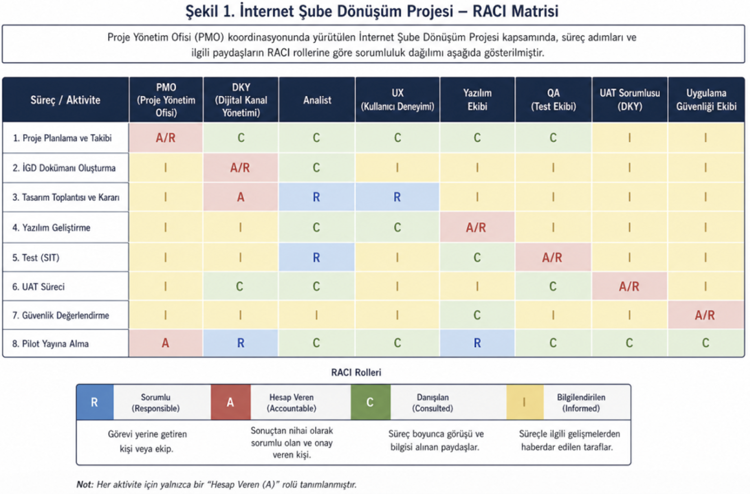
To illustrate this interaction, an example of a multi-stakeholder Online Banking Transformation Project can be considered. The project process includes the creation of business requirements, design decision-making, software development, testing phases, user acceptance testing (UAT), security assessment, and pilot deployment.
This multi-layered structure necessitates clear role distribution among stakeholders. For example:
- In defining business requirements, the business unit may assume both Responsible and Accountable roles.
- During the design phase, analysts and user experience teams are Responsible, while the business unit remains Accountable.
- In testing processes, the quality assurance team takes on the Accountable role, while analysts actively participate in validation activities.
- In UAT, the business unit serves as the final approval authority.
- During the security assessment stage, the application security team assumes ownership of the process.
This example demonstrates that the RACI approach not only defines roles but also makes inter-process dependencies and decision mechanisms visible. As a result, role conflicts among project teams are minimized, and communication becomes more predictable and manageable.
6. Evaluation and Discussion
Although the RACI approach offers significant advantages, it also presents certain limitations in practice. Overly detailed RACI matrices may reduce flexibility and create bureaucratic overhead. Additionally, evaluating stakeholders solely based on predefined roles may lead to neglecting their expectations and levels of influence.
Therefore, using the RACI approach in conjunction with stakeholder analysis tools can provide a more balanced and holistic management perspective.
7. Conclusion
The RACI approach is a valuable tool that contributes to clearly defining roles and responsibilities in project processes. When integrated with stakeholder management, it enables more effective communication and coordination among project teams.
In conclusion, modern project management requires the combined use of both technical tools and human-centered approaches. The RACI model can be considered an essential component of this integrated perspective.
References
- Freeman, R. E. (1984). Strategic management: A stakeholder approach. Pitman.
- Kerzner, H. (2013). Project management: A systems approach to planning, scheduling, and controlling (11th ed.). John Wiley & Sons.
- Project Management Institute (PMI). (2017). A guide to the project management body of knowledge (PMBOK® Guide) (6th ed.). Project Management Institute.
- Bourne, L. (2015). Stakeholder relationship management: A maturity model for organisational implementation. Gower Publishing.