




























 Back
Back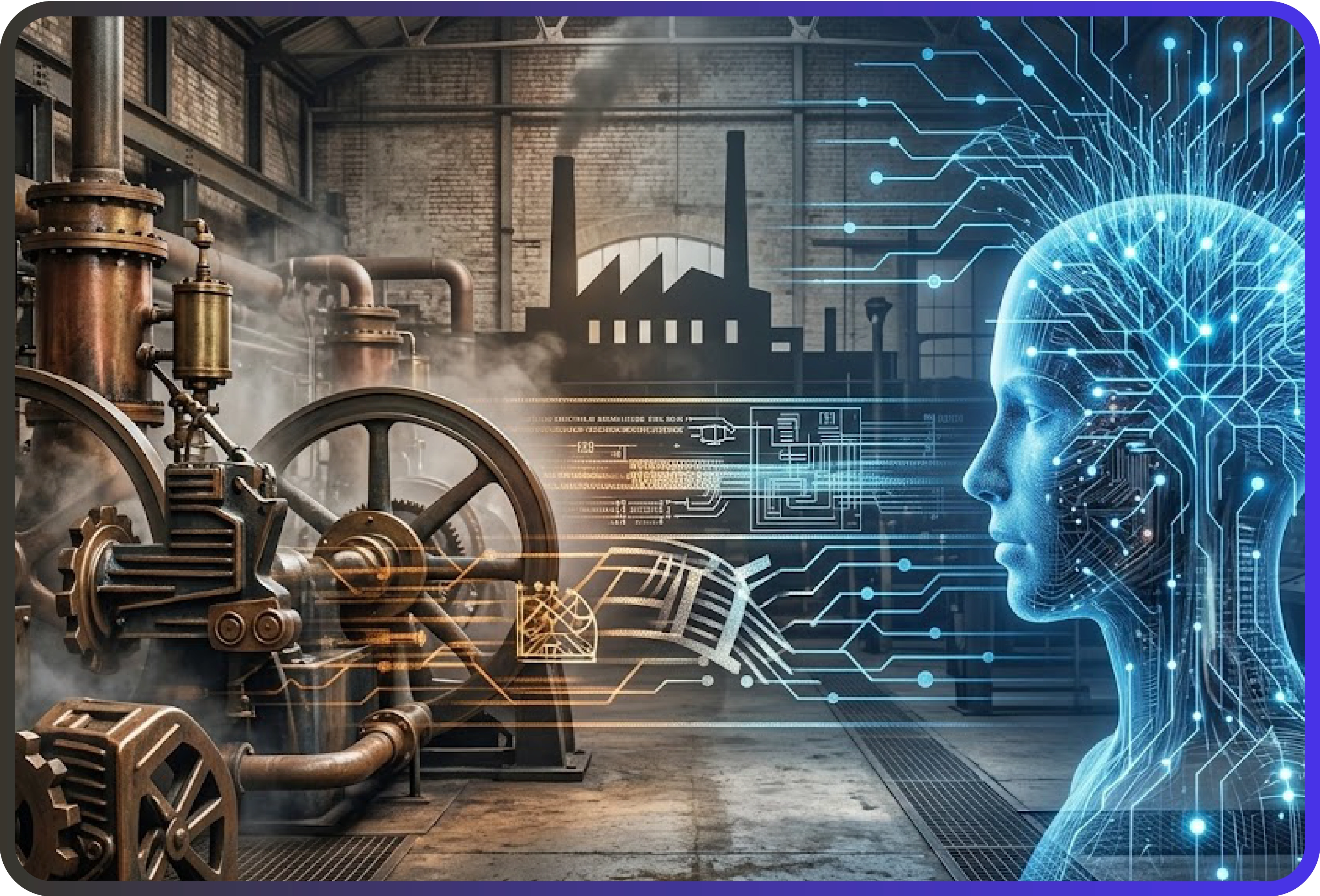
From the Steam Engine to Artificial Intelligence: Two Major Leaps in Human History
The Industrial Revolution: The Period When the World Began to Transform
Throughout history, people have always been in a state of search and therefore change for many different reasons such as security, shelter, agriculture, and transportation. However, since technical progress has not always been very rapid, the pace of the desired change has also varied from period to period. In fact, with the beginning of the Industrial Revolution, a new chapter was opened in human history, and the speed of change and transformation reached a level that cannot be compared with previous centuries.
To express the impact of the wave of change that began with the Industrial Revolution, as stated by Hans Freyer in his book titled The Industrial Age, the railway systems established between 1830 and 1870 eliminated horse-drawn carriages that had been used for approximately 4,000 years. In other words, in the field of transportation, more change occurred in those 40 years than in the previous 4,000 years.
Thanks to railway networks spreading across countries and steamships being able to travel freely across oceans without the need for any wind, the world began to change very rapidly in the 1800s. Because of this revolution in transportation, the raw materials needed could be easily transported from very distant countries to industrial production centers, and the goods produced in very high quantities in these centers could also be easily shipped to all corners of the world. This situation, which can be seen as the fundamental principle of the Industrial Revolution, caused all balances in the world to change.
With the Industrial Revolution, people left their existing homes, villages, and jobs and began to settle in city centers to work in factories. In this new situation, the social structure also completely changed, and the working class emerged for the first time during that period.
A New Turning Point: The Age of Artificial Intelligence
With the Industrial Revolution, as I partially stated above, many craftsmen left their professions and began working as laborers in factories. This was because new factories were constantly being established, and a serious need for human resources emerged to staff them. In addition, while the world population was 1 billion at the beginning of the 1800s, today it has reached 8.3 billion.
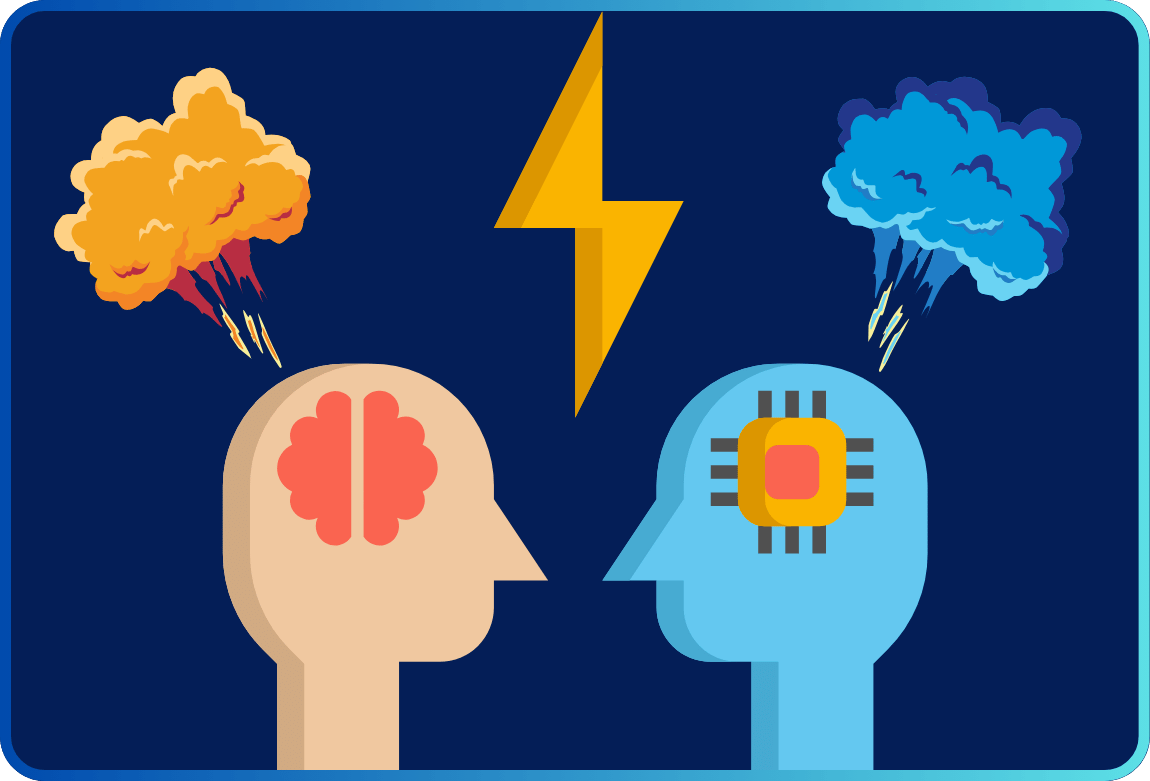
Just as the Industrial Revolution reshaped the world in many areas, today we see that the age of artificial intelligence can create a similar impact on people and institutions. In fact, with the age of artificial intelligence, we are at a breaking point, a point of change and transformation similar to the Industrial Revolution. One of the most fundamental differences here seems to be the speed of this transformation process. In other words, unlike the Industrial Revolution, where the process was expressed in decades, we have already begun to see the effects of the wave of change and transformation brought by the age of artificial intelligence in a much shorter period of time.
The fact that Chat GPT, one of the most popular artificial intelligence applications, reached 100 million users in just 2 months shows how rapidly artificial intelligence has entered our lives and how quickly it has spread among individual users.
According to Gartner’s research, 79% of CEOs believe that artificial intelligence will be the most important technology affecting industries in the next 3 years. In addition, it is predicted that by 2027, exams testing candidates’ artificial intelligence proficiency will be applied in 75% of recruitment processes.
Today, together with artificial intelligence, we are discussing something slightly different in terms of human resources compared to the period when the Industrial Revolution took place. Which jobs artificial intelligence and artificial intelligence agents will completely eliminate is one of the topics that everyone is most curious about. However, it is worth emphasizing the following: Just as a brand-new working class emerged with the Industrial Revolution, today we see that a brand-new class that is “data and artificial intelligence skilled” is being born with artificial intelligence. According to Gartner’s estimates, by 2027, exams testing candidates’ artificial intelligence proficiency will be applied in 75% of recruitment processes. This shows that using artificial intelligence effectively is becoming more of a necessity than a choice.
A Roadmap for Organizations: Creating Value from Artificial Intelligence
So what should organizations do in order to obtain tangible benefits from artificial intelligence as soon as possible and not miss this transformation process? It is undoubtedly possible to address this issue within a very broad framework. However, here I will touch upon 5 main points that I consider important.
- Using Artificial Intelligence with a Customer-Centric Approach
I believe that the first thing to do is for organizations to focus not on their own problems, but on the problems of the customer. In other words, using artificial intelligence to provide customers with a better experience should be the top priority of organizations.
- Transforming Human Resources
Secondly, it is necessary to put forward a new strategy to create a human resource pool with artificial intelligence competencies. On the one hand, increasing the artificial intelligence and data competencies of the existing workforce, and on the other hand, making new hires by taking future competencies into account should be among the main elements of this strategy.
- Strengthening the Data Infrastructure
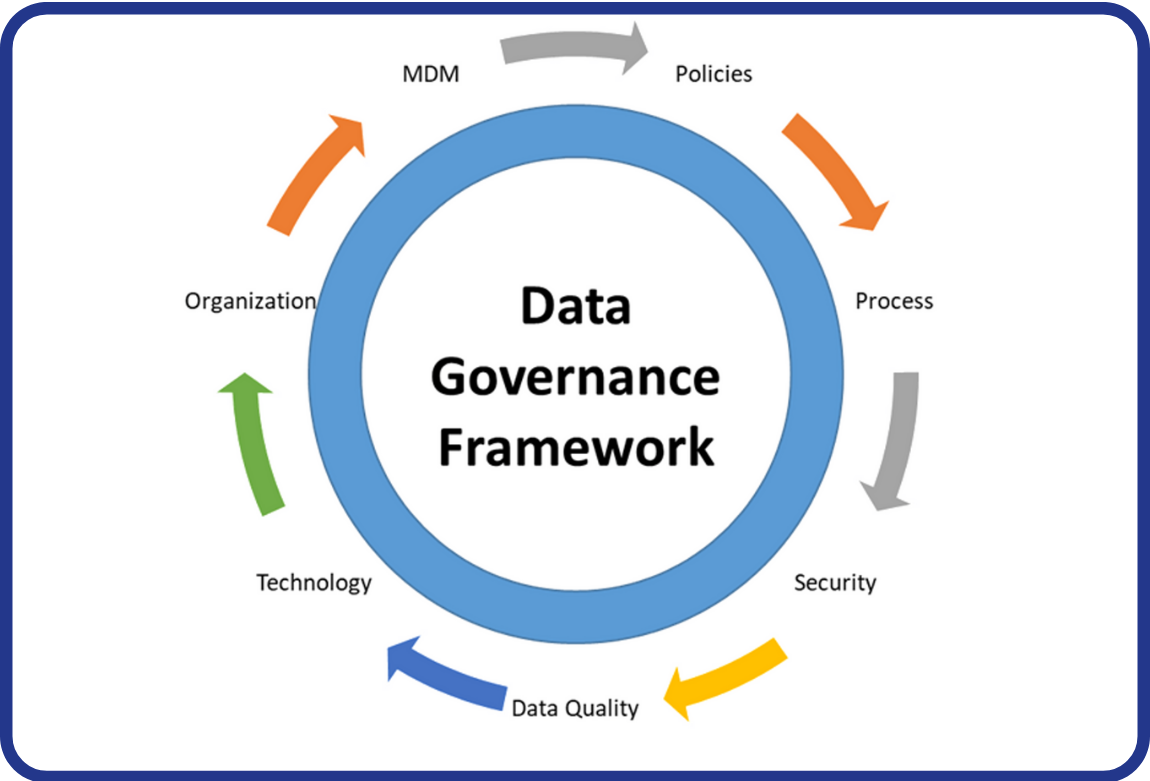
Thirdly, strengthening data foundations and making data usable in artificial intelligence models should be among the top priorities. Because I can easily say that one of the main reasons why artificial intelligence projects fail is deficiencies in data infrastructure and data quality.
- Building the Artificial Intelligence Portfolio Correctly
Fourthly, I find it very valuable to focus on areas where we can create the most value in the fastest way with artificial intelligence. Because the resources of organizations will never be sufficient to implement all targeted projects at the same time. In other words, there will always be more good projects than available resources. In this context, I believe that correctly analyzing the artificial intelligence project portfolio and making the right project prioritizations is very important.
- Integrating Artificial Intelligence Across the Entire Organization
Fifthly, it should not be forgotten that artificial intelligence projects can only be successful with full alignment and collaboration between IT and business units. In other words, in order to create value and obtain effective results with artificial intelligence, the voice of artificial intelligence needs to resonate across all departments of organizations.
The Unchanging Nature of Transformation
In summary, the Industrial Revolution and the age of artificial intelligence appear to be two periods that are similar to each other in many respects. While the Industrial Revolution caused a transformation with steam engines, trains, iron, steel, and motors, in the age of artificial intelligence, data and algorithms stand out as elements that accelerate change.
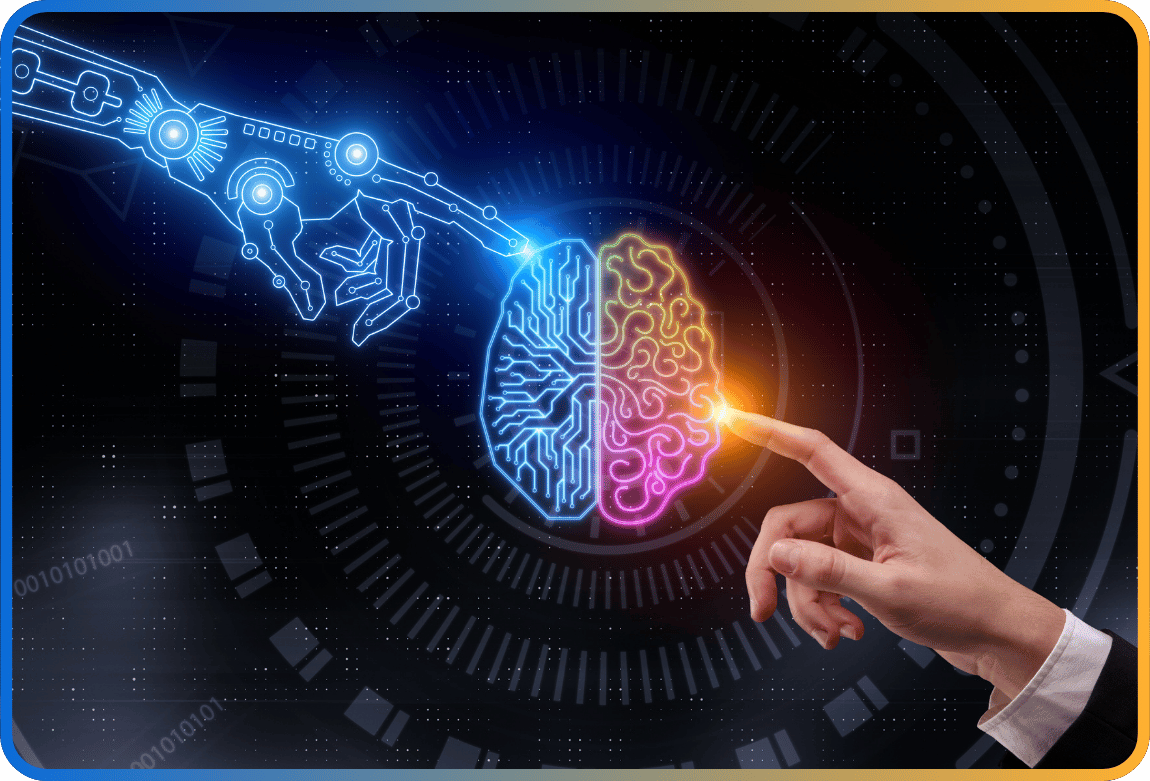
While the combination of physical strength and machines caused a transformation in the Industrial Revolution, today we see that artificial intelligence enhances mental power in decision-making mechanisms and many other areas.
While massive factories played the leading role in the Industrial Revolution, today they are being replaced by massive data centers. While the working class was born with the Industrial Revolution, the age of artificial intelligence is giving rise to knowledge workers and even artificial intelligence agents.
Just as the Industrial Revolution reshaped the world, today we can clearly see that artificial intelligence is taking both the world and our decisions to another level. While those who gained the most value from the Industrial Revolution were those who used machines in the most correct way at that time, it seems that today’s winners will be those who make the most effective use of data and artificial intelligence.
As Heraclitus of Ephesus said, the only thing that does not change in life will continue to be change itself.